
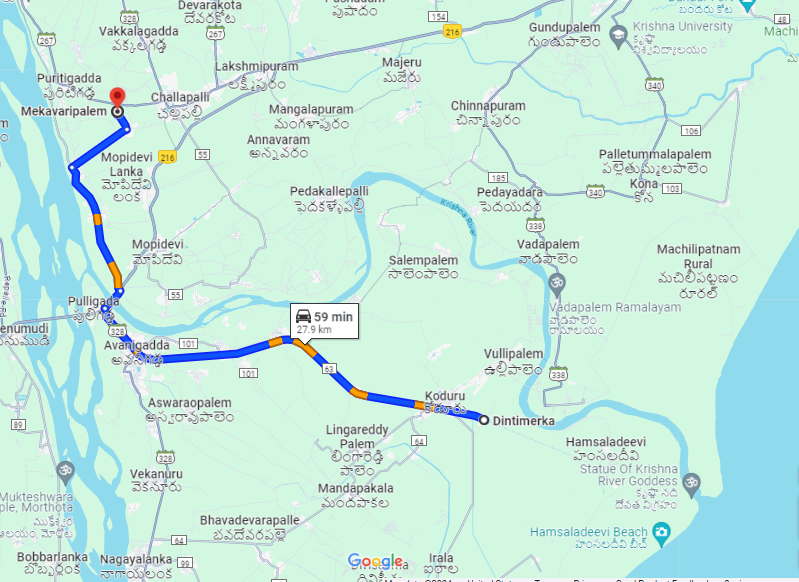
My maternal grandmother, Swarajyam Amaraneni, who was like a second mother to me, passed away on December 27, 2022. As we did when my grandfather, her husband of 40 years passed away in 1990, we took her ashes back to India, to the village where they lived when they were raising their children, and where her mother, my great-grandmother, lived. Dintimerika is a tiny dot on the map, close to the Bay of Bengal, and so close to the sea that my grandfather, a marine biologist, was able to do his research there when my mother and her siblings were young.
When we took my grandfather’s ashes back to India in the summer of 1991, my mother still had all of her siblings and her mother. In December 2023, almost one year after Grandma passed away, my mother, her brothers and sister, my brother and cousin, and several other close family members, gathered in Dintimerika to immerse her ashes (asthi visarjan is the Hindu ceremony) in the Bay of Bengal to join my grandfather, and to celebrate my grandmother’s 92 years on this Earth.
I barely remember what happened when we released Grandpa’s ashes in 1991. I was 13 years old. I do remember that we had to go in boats along the Krishna River to reach the sea since the roads were not passable. I do remember playing cards in the boat… with the wind whipping, and the boats rocking along the river on the way to the Bay of Bengal, we played rummy. I do remember getting caught in a torrential downpour soon after we reached the beach. But I don’t remember releasing Grandpa’s ashes. This time, we were releasing the ashes of my last grandparent.
My father’s parents passed away in 1986 and 2007. They lived not that far from Dintimerika, in another small village called Mekavaripalem. We visited my dad’s family in Mekavaripalem on the way from Vijayawada (where we flew into) to Dintimerika. My aunts and uncles and cousin from the Meka side of the family actually came to the celebration of my Amaraneni grandmother’s life the next day.
That’s the thing with Indian families, and I think with many families outside of Western civilization. Even though the individuals are legally bound, the families are spiritually bound together. I’ve visited grandparents and aunts and uncles that I am related to through marriage, and I’m as close to many of the cousins by marriage as I am to those I am related to by blood. Family is family, blood or not.
I’m getting ahead of myself though. We need to start at the very beginning of my trip which included plenty of highlights, and some unfortunate roadblocks). Before I even left Atlanta for my flight scheduled Monday, December 4, I had a major snafu. My flight from Atlanta to Amsterdam was canceled on Saturday, December 2 because of a snowstorm in Munich. Apparently, the storm in Germany meant my plane from Atlanta wouldn’t be available. Thankfully, a good friend sat on hold with KLM and got me booked on a flight from Atlanta to Delhi through Paris. I had an hour layover in Paris, which was perfect. Then I get to Delhi for a 4 hour layover, or so I thought. 10 hours later, I board my flight to Hyderabad, where my mom had been for about a week already.
Charminar
We were supposed to go to Chennai the next day, but the cyclone that had come through earlier that week canceled that trip, so we had a couple of days in Hyderabad. I had wanted to see Charminar the last trip, but we didn’t have time, so I convinced a friend that lived nearby to go with me. I was delighted to take my first metro train ride in India, since traffic is always a mess, and especially this week since they had just had an election earlier that week, and the inauguration of the new chief minister (like a governor) that day.
Charminar was built by Sultan Mohammed Quli Qutb Shah in 1591, designed by Iranian architect Mir Momin Astrawadi. The square-shaped structure has four pillars (char=4, minar=towers) and intricate carvings, and is made of granite and lime mortar.
There are several theories about why Charminar was built:
1) in honor of the Sultan’s wife, Bhagmati. It is rumored that Charminar is located where the two met.
2) to celebrate the end of a plague
3) to honor the death of his son-in-law who was killed in a battle
4) to commemorate the start of the second Islamic millennium


And no visit to India is complete without homemade dosas – along with my custom mix of mango pickle and sugar. My friend took me to a restaurant, and their dosas were good, but nothing beats homemade!
Bangalore
The next day, we flew to Bangalore to visit some extended family, and pick up several passengers. Ranga-mama (second or third cousins to my mom) is the uncle that made all of the arrangements for the event. His parents are the ones who originally lived in Dintimerika, and his mother still lives there. Sanja-atha knows the way to my heart is through my appetite, because she made all of my favorite foods – okra, dal and mango pickle. Lunch was followed by a swing – it helps with digestion, right?
Bangalore is also where my great-aunt (by marriage) lives. Her daughter is married to my uncle, and they live near me in Atlanta. Like I said, families, not just the spouses, are bound by marriage. My great-uncle passed away in 2021, so this was my first time visiting since then. My last visit in 2017 was just after he had surgery, but he was still his usual jovial self. After we saw my great aunt, my cousin Maanasa and I took an Uber to a brewery to meet our cousin (by marriage), Smriti. The last time I visited, I wasn’t able to meet her, and I finally got to meet her husband Rajiv.
Since there were so many of us (me, my mom, Maanasa, and my cousin Rajiv and his wife), Maanasa, Mom and I got a hotel room, and then the six of us (Sanja-atha, Ranga-mama, my mom, Maanasa, my cousin Rajiv and his wife, and me) met my brother, Sarat, at the airport the next morning, where he had just arrived via Paris.
From Bangalore, we flew into Vijayawada, where we met my aunt and uncle (mom’s brother and sister) and my uncle’s friends that were traveling with him. The restaurant that we ate lunch at didn’t know what to expect with this crazy group of NRIs (non-residential Indians), a Filipino lady (Eva, who was my grandmother’s caretaker and is like my aunt), and a White couple (my uncle’s friends John and Diane who live in Louisiana). I’m sure they were glad when we left – in 3 cars. One car stayed in Vijayawada. Eva, John and Diane weren’t ready for an overnight village stay just yet– a hotel was adventurous enough! The other two cars headed for Dintimerika, with one car (me, mom, Sarat, Maanasa and the driver) making a stop in Mekavaripalem to visit my dad’s family. The other car went in search of 101 coconuts (more to come about this…)
While the house were my dad grew up has been torn down, my aunt and uncle built a new house where it once stood, and my uncle is still a farmer, just like he was before I was even born. My dad’s sisters also came to see us from where they live – Bandar and Lankapalli. And my cousin Satish came all the way from Pune to see us! He is the true ringleader of the Meka cousins, like I am with the Amaraneni cousins. We couldn’t stay long to visit though, because we really had to get on the bumpy road to Dintimerika before it got too dark. Besides, we would see them again at the event the next day!
These tiny villages are 16 miles (27 km) apart, but it took us several hours to make this trip. If you think the potholes in New Orleans and Atlanta are bad, the road between Avinigadda to Dintimerika (16 km/10 miles) is saying, hold my beer. Those 10 miles took us over an hour. Then there were nature’s speedbumps – goats, cows, water buffalo. You never know what you’ll see in rural India!
Dintimerika Adventures
When we arrived in Dintimerika (after dark), we found our sleeping quarters (an open-space office or multi-purpose building Ranga-mama built behind his parents’ house for his company) and helped with preparations for the event the next day. I watched the caterers preparing food for the next day – chopping vegetables and preparing seasoning and spices. They were working outside because a) they were making enough food for over 100 guests and b) Indian food smells, so it’s best to cook outside! The food we ate for dinner that night was prepared in the kitchen in the house though.
My aunt put Maanasa, Sarat and me to work putting together gift bags for the over 100 guests that would be in attendance the next day. My box cutting down skills came in handy once again. Despite the jet lag (I had only arrived 4 days before), we conked out early, which was smart since there wasn’t great Internet, and there’s not a lot to do without a tv or any entertainment outside of the stray dogs. Besides, we had to be up early to help!
The day of the Asthi Visarjan
It turns out I didn’t need an alarm clock, because the caterers were up even earlier than we were, and they were set up between the main house and the multi-purpose building we were staying in. It was like watching several shows on the Food Network at once.
The caterers Ranga-mama brought in were amazing. They served breakfast and lunch to over 100 people, including several courses for each meal. They turned over the outdoor seating several times for each meal since we only had room for about 30 people to sit down.
This was as much a family reunion as it was a celebration of life for my grandmother. I saw relatives that I have not seen in probably 20 years, and even met people that knew my mom and aunt and uncles when they were little kids. One man in particular stood out to me. His father helped my grandfather with his research, taking Grandpa by boat to an island to do his research. They would be gone for several days at a time. The man said he remembered playing with my mom and her siblings. Sadly, he lost his wife in the same cyclone that claimed my great-grandmother in 1977. Once he found out we were having this celebration of life for Grandma, he knew he had to be here to see my family and his childhood playmates again.
After everyone ate breakfast (which ended around noon…) we headed to the Hamsaladeevi Beach where the Asthi Visarjan would take place. If you remember, the last time we did this, we had to take boats from the river to the beach since there were no roads. This time, we literally drove right onto the beach. Usually visitors to the beach have to park in a certain area, but since we were bringing the ashes, the police let us bring the vehicles to the immersion point. Also, the police were there to make sure we didn’t go all the way into the water. The cyclone from earlier that week left the sand at the water’s edge very prone to erosion, and the tide of the bay is strong enough to sweep you away, especially with the remnants of the cyclone still around.
The ceremony the priest performed was fascinating. I don’t remember if Grandpa’s ashes got this elaborate of a ceremony, or if the rain prevented it. Grandma got a clear day, and a very thorough priest! My brother (who was raised by Grandma until he was 11) and the two remaining sons of my grandmother, Bharadwaj and Kumar, took part in the ceremony with the priest. There were certain points where my mom and aunt as the two daughters, were asked to come forward, and then when Maanasa and I were asked to participate as the two granddaughters present. For such a matriarchal society, men still get the important roles in Hindu ceremonies.
There was a ritual when the ashes were taken to the water’s edge that I wasn’t able to completely capture because I didn’t have a great angle, but it involved my uncle Bharadwaj (since he is the oldest son now) turning around several times and lowering the ashes behind his head into the sea. After the ashes were absorbed by the Bay of Bengal, we loaded up the cars, and headed to the temple. It was time for the coconuts.
Coconut Breaking at Sri Venugopala Swamy Temple in Hamsaladeevi
Ranga-mama said we had to break 101 coconuts at the temple in Hamsaladeevi, the village closest to the beach. Why 101? Because my great-grandmother said so. When my grandfather was on one of his 3-day research trips, a storm came out of nowhere. My great-grandmother was so concerned for her son-in-law’s return and well-being, she prayed for his return and told God she would sacrifice 101 coconuts. First of all, my great-grandmother was not a religious person. Like many in the village, she was a member of the Communist Party. And we’re just not a religious family. Secondly, as an Indian person, numbers should always end in 1; if you give a gift, it’s not $1,000 or $150 – it’s $1,001, or $151. It’s an auspicious sign to have the 1 or any odd number at the end. So my great-grandmother said, I will sacrifice 101 coconuts for Venkataramaiah’s return.
So Ranga-mama said, we need to sacrifice 101 coconuts for my grandmother, to appease her mother’s wishes from over 65 years ago. Let me tell you, breaking a coconut is not as easy as it looks! My uncles and brother got first dibs. I decided to wait until I’d seen several (dozen) people do it first. I am so glad that my great-grandmother didn’t say 1,001 coconuts, or we may still be there, breaking coconuts!
Oh, and why coconuts? According to Hindu tradition, your offering of a coconut to God is like offering yourself. The outer shell of coconut is comparable to the human ego, while the white and soft inner part is symbolic of peace. It is a sign of new beginnings, or breaking free from the past. You may see someone break a coconut when they buy a new house, start a new job, or welcome a family member to their home. We are signifying Grandma’s passing by breaking these coconuts.
The temple in Hamsaladeevi was built during the Chola dynasty, probably starting in the 11th century, but it was not completed until recently.
Though we didn’t have time to do this, supposedly, if you stand on one of the outer structures of the temple, you can see the confluence of the Krishna river into the Bay of Bengal, where you can see three different colors of water (Sagara Sangamam). If you’re lucky, you’ll see the swans that give the area the name “Swan Island”
Lunch and Remembering Grandma
After we left the temple, we gathered in the multi-purpose room (where my brother and cousins and I had slept the night before) to celebrate Grandma’s life. Ranga-mama prepared a slideshow of photos from Grandma’s life, gathered from all of us who knew her best. He shared his thoughts, and asked several of us to talk about Grandma, including my aunt and Eva. It was so touching to see how many people came to remember my grandmother, who didn’t have any great achievements on paper, but whose life clearly had an impact on so many.
Lunch was again, superb. We feasted on lamb, chicken, and fish curries, several vegetable curries and chutneys, and of course, dessert. I definitely needed a nap after all this food, but we had to get back to Vijayawada so we could catch a flight to Visakhapatnam the next morning. But first, we had to visit the home of another great-uncle (by marriage), who passed away a few years ago, but visiting his home is a childhood memory that I couldn’t resist. This great-uncle, a leader of the Communist Party of India, was a very good friend of my great-grandmother, the reason that my great-grandmother moved to Dintimerika. Both sets of my grandparents were in the party as well, which I guess is how my parents were set up for their arranged marriage. Full-circle, I guess?
Family Visit in Visakhapatnam
Our trip was coming to a close. The last city to visit was Visakhapatnam, where my uncle and aunt live. My uncle Apparao, or Appa-mama, as I call him, is my mother’s first cousin. He and his brother and sister were raised by their grandmother after their mother died of tuberculosis before my grandmother was even married. My mom and her siblings were also raised by this same grandmother since my grandfather was doing his research, and my grandmother was often helping him. Appa-mama was an archaeologist by profession, and a lover of history like myself, so I always felt a kinship to him. He visited the U.S. often, the last time when my mom was sick in 2016, and often visited his son, my cousin, Ujwal, who lives in New Orleans. He was already suffering from dementia then, but he knew who we were that trip. The next December in 2017 when we visited, it took him a few minutes to recognize Mom, and I had to tell him who I was. This trip was something altogether. Words can’t express the sadness I felt seeing him when we first arrived. Seeing someone who was so full of life and knowledge not being able to communicate or even walk or move on his own is one of the saddest things I have experienced. I don’t even know if he knows that his aunt, my grandma, is gone. We spent almost 24 hours with him, and even if he didn’t know who any of us were, it was time well spent. Mom was also able to see an old family friend, so we did have some happy moments despite the sadness of my uncle’s health.
The last full day in India, we flew back to Hyderabad, and prepared for the trip home. This involved a day of shopping,including buying sweets and chutneys. The lady who helped us was named Sravanthi!

Thankfully, it was uneventful, other than the usual craziness of security at CDG. I was very grateful for the business class ticket that granted me access to the super bougie Business Class Lounge! I am sure I will be returning soon, as my cousin Satish informed me that he is planning a celebration of our grandfather’s 100th birthday. While we don’t know his birthdate, we do know he was born in 1924, so we can celebrate all year long!
Although all four of my grandparents have now passed, I do have happy memories of them all. I wish I was able to spend more time with my father’s parents, but since they lived in India, we traveled back to visit them as much as possible. Living close by my maternal grandparents was a blessing though, and so much of my childhood was spent in their home that I considered their house in Ocean Springs my childhood home more than the ones where I lived in Ocean Springs and West Point. After my grandmother was widowed, I was lucky to spend a great amount of time with her, both when she lived with us, and during our many family get togethers. She even took me on a trip to Italy after I graduated high school.

I can’t help but think how happy she would be that our journey to deliver her ashes back to her homeland sent us on a trip around the country at the same time.
 Sravanthi Meka